Reinventing mobility in the medical sector: the motorized wheel for enhanced comfort and safety
In healthcare facilities, every movement matters.
Moving a patient, repositioning a medical bed, or operating a patient lift involves handling heavy loads, sometimes several hundred kilograms, and doing so multiple times a day.
These repeated efforts are part of caregivers' daily routine. Yet they are also one of the leading causes of musculoskeletal disorders (MSDs), the primary cause of absenteeism in the medical sector.
Faced with these physical constraints, assisted mobility solutions are taking on strategic importance today.
Among them, the motorized wheel stands out as a key innovation to improve both work ergonomics and travel safety.
The motorized wheel: intelligent assistance for medical mobility
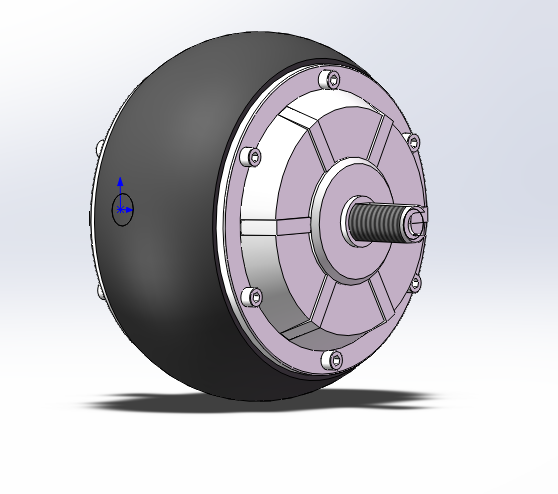
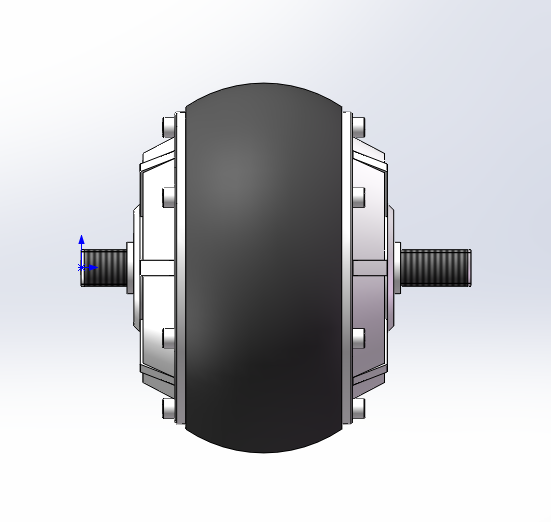
The motorized wheel provides traction and maneuvering assistance for mobile medical equipment.
Specifically, it allows the caregiver to guide the movement rather than providing the effort required to move the load.
Result:
- fewer physical constraints,
- smoother movements,
- better trajectory control, even in constrained environments (narrow corridors, uneven floors, slopes).
This technology integrates directly into existing devices without compromising their usage or safety standards.
Concrete benefits for caregivers and patients
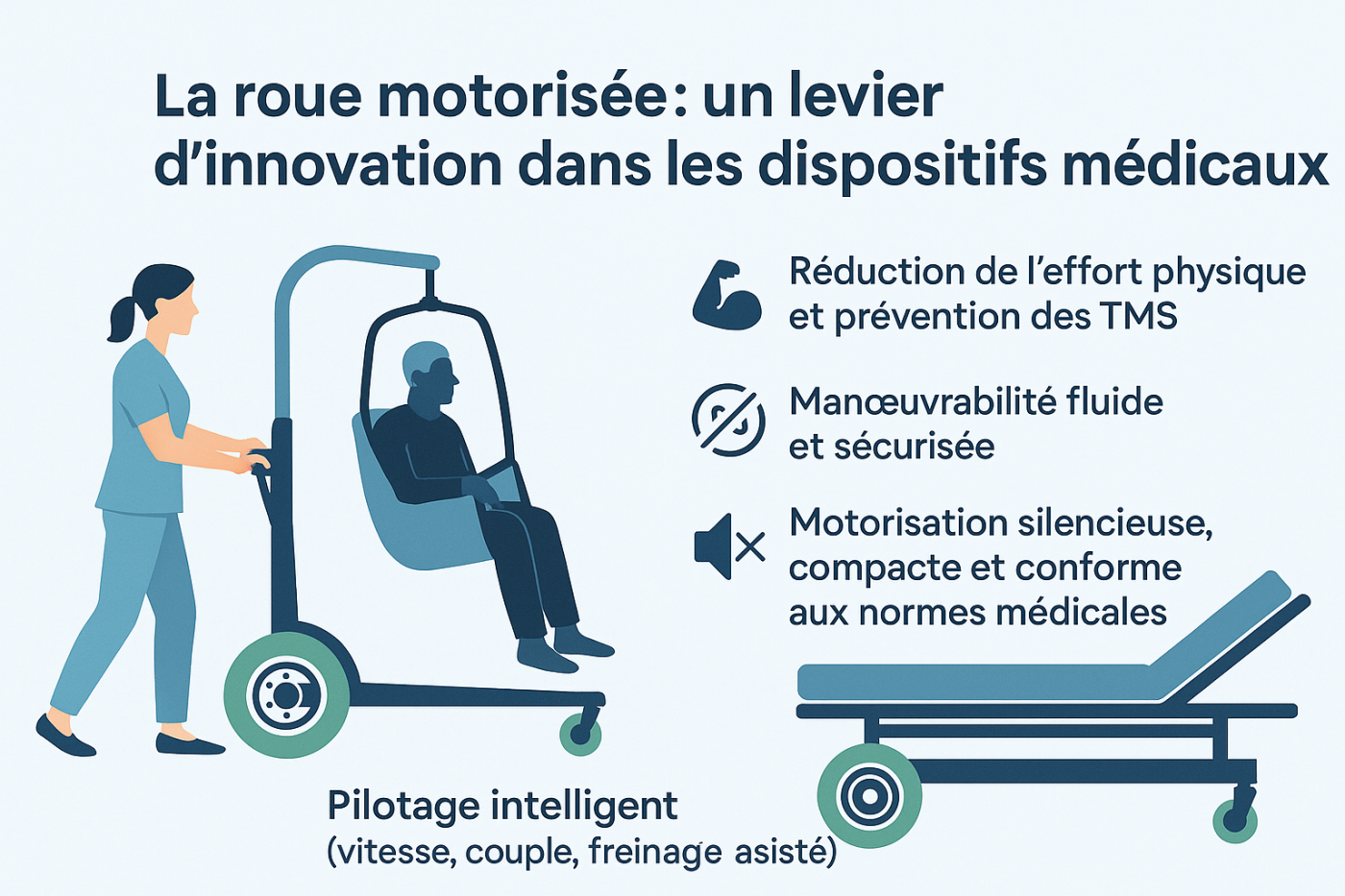
Drastic reduction of physical effort
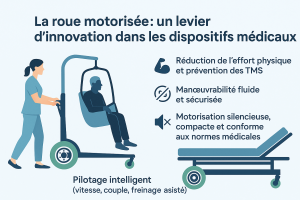
The motorization takes care of the mass to be moved, including on slopes or uneven surfaces. Caregivers no longer have to "strain" their backs or shoulders.
Prevention of musculoskeletal disorders and better ergonomics
The movements are more natural, the postures safer. The risk of injuries related to handling decreases significantly, helping to preserve staff health over the long term.
Exceptional maneuverability
Smooth start, automatic braking, smooth rotation around the axis:
the equipment becomes easy to maneuver, even in tight spaces or during frequent direction changes.
Simple and secure integration
Motorized wheels are designed to meet medical constraints:
compact and silent motors,
compliance with medical standards (EMC, electrical safety),
compatibility with cleaning and disinfection requirements.
Smart control
Adjustable torque and speed, control integrated into equipment:
the motorization adapts to different uses and user profiles.
Concrete applications in healthcare facilities
The motorized wheel naturally finds its place in numerous mobile medical devices:
- Assisted-movement medical beds
- Hospital handling and logistics carts
- Patient lifts and stand aids
- Transfer chairs
- Rehabilitation platforms and therapeutic mobility equipment
Each application benefits from an immediate gain in ergonomics, safety, and user comfort.
An innovation at the crossroads of mechatronics and ergonomics
At the intersection of mechatronics and ergonomics, the motorized wheel redefines assisted mobility in the medical sector.
It contributes to:
- improve patient comfort and safety during transport,
- protect the health of nursing staff,
- simplify and make daily tasks more reliable.
More than just a technical component, it becomes a true driver for improving working conditions and the quality of care within healthcare facilities.